Search
Log in
0
items in cart
Home
About Us
About Our Foundation
Vision
Our Board
Our Team
FAQs
Get Involved
Community Events
Fundraise for Us
Leave a Gift in Your Will
Charlies Changemakers
In Celebration Giving
Corporate Giving
Giving Day
Share Your Story
AIRD Registry
Containers for Change
Grants
About Our Grants
Bright Ideas Grants
Discovery Grant
Ray Florence Shaw Grant
Transformational Grant
Partnership Grants
Stories
Patient Stories
Researcher Stories
Donor Stories
Project Stories
Latest Publications
Get in Touch
Donate
Now
Home
About Us
About Our Foundation
Vision
Our Board
Our Team
FAQs
Get Involved
Community Events
Fundraise for Us
Leave a Gift in Your Will
Charlies Changemakers
In Celebration Giving
Corporate Giving
Giving Day
Share Your Story
AIRD Registry
Containers for Change
Grants
About Our Grants
Bright Ideas Grants
Discovery Grant
Ray Florence Shaw Grant
Transformational Grant
Partnership Grants
Stories
Patient Stories
Researcher Stories
Donor Stories
Project Stories
Latest Publications
Get in Touch
Donate Now
Log in
0
items in cart
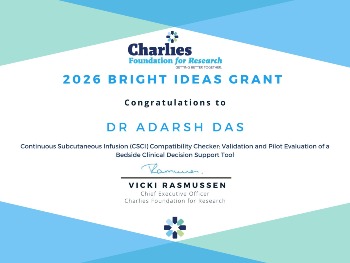
Dr Adarsh Das - Department of Palliative Care and Med onc advanced trainee
Continuous Subcutaneous Infusion (CSCI) Compatibility Checker: Validation and Pilot Evaluation of a Bedside Clinical Decision Support Tool
Back to Bright Ideas Grant
Log in to access your account
Email
Password
Forgot Your Password?
We've sent you an email with your temporary password
Log In
Next